| 6 - Honoring Philocrates of Olympos |
|
|
|
|
|
|
|
| |
|
FBA2022-6013 |
|
|
|
|
|
|
|
|
| Project 013: 6 |
Inventory No: AC-3 |
|
|
|
|
|
|
|
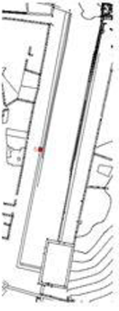
| Coordinat |
36°31'27.72" K /
30°33'8.09" E |
|
|
|
|
|
|
|
Measurement
Accuracy
|
| 1 m
in areas with dense vegetation |
|
|
|
|
|
|
|
|
| Location |
in-situ
incertus |
|
|
|
|
|
|
|
| Found In |
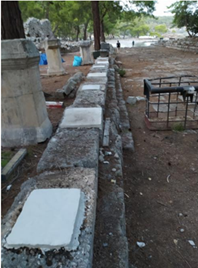
It was taken from the
South Harbor and stands on the steps on the west side of the main street. |
|
|
|
|
|
|
|
| Date Range |
Second half of the II. century
AD or first half of the III. century |
|
|
|
|
|
|
|
| Material |
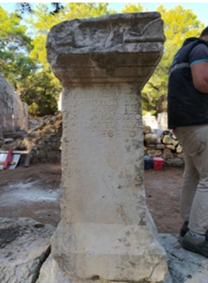
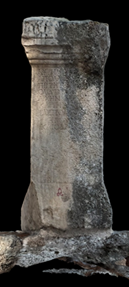
A profiled marble
pedestal. The left side is completely erased due to waterlogging. In the
first line the letters Ν and Η are given as ligatures. |
|
|
|
|
|
|
|
| Measures |
Height: 1.45 m; Depth:
0.51 m; Width: 0.50 m; |
|
|
|
|
|
|
|
| Inscription
Contents |
|
|
|
|
|
|
|
| Hellenic |
|
|
|
|
|
|
|
|
|
|
|
|
|
|
|
| Translation |
|
|
|
|
|
|
|
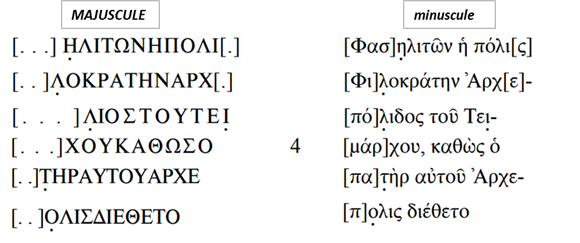
| "The
city of the Phaselisians (erected) Philocrates, son of Arkhepolis, son of
Teimarkhos, as his father Arkhepolis had determined." (Tüner Önen,
2008:340). |
|
|
|
|
|
|
|
| Letter
Attribute |
|
|
|
|
|
|
|
| Letter
Character |
Processed as ligature |
Letter Height |
0.035-0.040 m |
|
|
|
|
|
|
|
| Majuscule |
|
Minuscule |
|
|
|
|
|
|
|
|
| Conservation
Status of the Inscription Bearer |
|
|
|
|
|
|
|
| 1 |
Intervention Date |
Consevation Team |
Materials Used |
Changes Made |
|
|
|
|
|
|
|
|
11/6/2020 |
|
Blocking fee |
Ground Leveling |
|
|
|
|
|
|
|
|
Pre-conservation
view |
Post-conservation view |
Analysis |
|
|
|
|
|
|
|
|
|
|
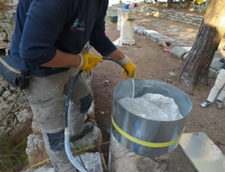
The inscription was fixed to its
base by applying blockage mortar to level the ground on which it will sit. |
|
|
|
|
|
|
|
| 2 |
Intervention Date |
Consevation Team |
Materials Used |
Changes Made |
|
|
|
|
|
|
|
|
11/12/2020 |
|
|
Placement |
|
|
|
|
|
|
|
|
Pre-conservation
view |
Post-conservation view |
Analysis |
|
|
|
|
|
|
|
|
|
|
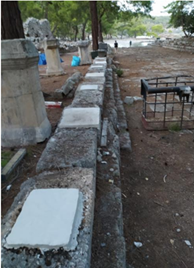
The inscription stele was also
consolidated on the main street and placed on the ground. |
|
|
|
|
|
|
|
| Edition |
|
|
|
|
|
|
|
| Adak – Tüner – Şahin
2005, 15 no. 11. |
|
|
|
|
|
|
|
| Text
Commentary |
|
|
|
|
|
|
|
| The family of Philocrates, honored here, resided in Olympos, the
southern neighbor of Phaselis. There he and his father built a common tomb
for their slave Epiktetos and his close relatives1. The inscription on this
tomb was seen by L. Ross in 1844: Ἀρχέπολις
Τ̣̣ειμάρχου
καὶ
Φιλοκράτης
Ἀρχεπόλεως
τὸν τύμβον
κατεσκεύασαν
Ἐπικτήτῳ,
δούλῳ αὐτῶν̣,
καὶ γυναικὶ
τοῦ Ἐπικτήτου
καὶ τέκνοις
καὶ γαμβροῖς
καὶ ἐκγόνοις
καὶ νύνφῃ καὶ
γυναικὸς ἀδελφοῖς-
ἄλλῳ δὲ
οὐδενί ἢ ὁ
θάψας τινὰ ἐν
αὐτῶι (sic) ἐκτείσει
τῷ φίσκῳ den. φ′,
ὧν ὁ ἐλένξας
τὸ τρίτον
λήμψεται. Neither in this inscription
at Phaselis nor in the inscription at Olympos is an ethnikon given for either
person. (Tüner Önen, 2008:340). |
|
|
|
|
|
|
|
| Bibliography |
|
|
|
|
|
|
|
| 1 |
Akçay, A 2016, New
Technological Approaches Used in Cultural Heritage Research: The Case of
Phaselis Inscriptions. Unpublished Master's Thesis, Akdeniz University,
Antalya. |
|
|
|
|
|
|
|
| Research
Status |
|
|
|
|
|
|
|
| Research and
development studies are ongoing within the scope of FBA2022-6013. |
|
|
|
|
|
|
|
|
|
|
|
|
|
|
|
|
|
|
|
|
|
|
|
|
|
|
|
|
|
|
|
|
|
|
|
|
|
|
|
|
|
|
|
|
|
|
|
|
|
|
|
|
|
|
|
|
|
|
|
|
|
|
|
|
|
|
|
|
|
|
|
|
|
|
|
|
|
|
|
|
|
|
|
|
|
|
|
|
|
|
|
|
|
|
|
|
|
|
|
|
|
|
|
|
|
|
|
|
|
|
|
|